What Is the Best Month to Go to Sydney?
The best month to visit Sydney, decided on Bureau of Meteorology climate data, whale season, festival dates and crowd patterns rather than guesswork.
Sydney gets sold as a year-round city, and the climate record mostly backs that up: the annual mean maximum is 21.8 °C and the long-run average never pushes a month above 26 °C. But "fine all year" is not the same as "every month is equal". The Bureau of Meteorology's 162-year record from Observatory Hill, the whale migration calendar, the festival schedule and the school-holiday crowd cycle all pull in slightly different directions, and one narrow window satisfies almost all of them at once.
What Is the Best Month to Go to Sydney?
November is the best month to go to Sydney, with October a very close second. Both months sit before the December-February peak, when crowds peak and February is the cloudiest month of the year at just 5.3 clear days. October averages 22.2 °C and November 23.7 °C, whale season runs through November, and spring sunshine beats January's 6.8 daily hours. The long-run average maximum sits at 22.2 °C in October and 23.7 °C in November, September has the fewest rain days of any month (7.1 days with at least 1 mm), whale season is still running through November, and both months sit before the December-February peak, when crowds peak and February delivers the cloudiest skies of the entire year, averaging just 5.3 clear days.
That answer surprises people who assumed the southern-hemisphere summer was the obvious pick. December, January and February are the months the postcards are made of, and the water is at its warmest for swimming. But the data is blunt about the trade-offs. February averages 119.3 mm of rain, more than any month except June, and its 5.3 mean clear days make it the cloudiest month on the calendar. Peak season is statistically the greyest time of year in Sydney, a fact almost no guide mentions because almost no guide reads the table.
Spring also wins on light. October averages 7.2 hours of daily sunshine and 8.1 clear days, November 7.8 hours and 6.0 clear days, both ahead of January's 6.8 hours. The days are long, the UV is climbing but not yet at its summer extreme, and the harbour is working rather than festooned. If you want the full reasoning, the site's best time to visit Sydney guide breaks the year into seasons in more depth than one page can.
Which Month Is the Best to Visit Sydney?
November is the single best month to visit Sydney for most travelers: the average maximum of 23.7 °C sits within two degrees of the summer months, the sea is warming after winter, humpback whales are still migrating south with their calves, and accommodation holds at shoulder-season pricing before the December school-holiday surge. October is the close runner-up, slightly cooler at 22.2 °C on average. The average maximum of 23.7 °C is within two degrees of the summer months, the sea is warming after winter, humpback whales are still migrating south past the coast with their calves, and accommodation sits at shoulder-season pricing before the December school-holiday surge. October is the close runner-up, slightly cooler at 22.2 °C on average but with marginally better cloud statistics.
November's quiet advantage is that it is the last month before the city changes character. From late December through January, Sydney is on holiday: domestic visitor numbers peak, the Sydney in summer conditions bring extreme UV and the biggest beach crowds, and the Australia Day long weekend in late January books out foreshore restaurants weeks ahead. In November you get the same harbour, the same ferry network and the same long evenings with noticeably more room to enjoy them.
October carries one extra consideration: Vivid Sydney's dates are locked to late autumn (22 May to 13 June in 2026), so festival travellers should not chase spring for lights. But October is squarely inside the whale season, which runs May to November along the NSW coast, and the southern migration from August to November brings mothers and calves closer to shore than the faster northern run. NSW National Parks publishes the migration detail on its whale watching pages, and the site's own whale watching in Sydney guide lists the cruise options.
What Does Sydney's Weather Actually Do Month by Month?
Sydney's climate is milder and wetter than most visitors expect, with rainfall spread across the year rather than concentrated in a wet season. June is the wettest month at 133.1 mm on average, wetter than any summer month, while August is the clearest at 13.4 mean clear days and February the cloudiest at 5.3. Summer highs average 25-26 °C, winter highs 16-18 °C. June is the wettest month at 133.1 mm on average, wetter than any summer month, while August is the clearest at 13.4 mean clear days and February the cloudiest at 5.3. Summer highs average 25-26 °C, winter highs 16-18 °C, and frost is essentially unknown at sea level.
Here is the full record from the Bureau of Meteorology's Observatory Hill station, the long-run averages across 162 years of observations, published on the BOM climate averages page:
| Month | Mean max °C | Mean min °C | Mean rainfall mm | Rain days ≥1 mm | Mean clear days |
|---|---|---|---|---|---|
| Jan | 26.0 | 18.8 | 101.2 | 8.6 | 6.8 |
| Feb | 25.8 | 18.9 | 119.3 | 9.0 | 5.3 |
| Mar | 24.8 | 17.6 | 131.6 | 9.9 | 7.1 |
| Apr | 22.5 | 14.8 | 126.5 | 8.9 | 9.1 |
| May | 19.5 | 11.6 | 117.4 | 8.6 | 9.5 |
| Jun | 17.0 | 9.3 | 133.1 | 8.8 | 9.1 |
| Jul | 16.4 | 8.1 | 96.3 | 7.4 | 12.0 |
| Aug | 17.9 | 9.0 | 80.2 | 7.1 | 13.4 |
| Sep | 20.1 | 11.1 | 68.1 | 7.1 | 10.9 |
| Oct | 22.2 | 13.6 | 76.7 | 7.9 | 8.1 |
| Nov | 23.7 | 15.7 | 83.8 | 8.3 | 6.0 |
| Dec | 25.3 | 17.6 | 77.1 | 7.9 | 6.6 |
Two rows in that table do most of the work of this article. June's 133.1 mm makes it the wettest month of the year, ahead of high-summer February, which upends the assumption that rain in Sydney is a winter problem. And August's 13.4 clear days, with July second on 12.0, mean the middle of winter delivers the most reliable blue sky on the calendar. The days are short and the mornings are cold at 8-9 °C, but the light is real. More of these guides are collected on Sydney Travel Guide.
The month-by-month detail, including what each month means for swimming, events and pricing, is expanded in the site's Sydney weather month by month guide. One caution that applies across the whole table: these are long-term averages, not forecasts. Any individual week can buck them, and the honest way to use the data is to weight the odds, not to promise weather.
Is Winter Actually a Good Time to Visit Sydney?
Yes, winter is a good time to visit Sydney, and for a specific type of traveler it is the best time. July and August deliver the clearest skies of the year, daytime highs of 16-18 °C are mild by northern-hemisphere winter standards, and the city is at its quietest and cheapest between the June long weekend and the September school holidays. July and August deliver the clearest skies of the year (12.0 and 13.4 mean clear days), daytime highs of 16-18 °C are mild by northern-hemisphere winter standards, and the city is at its quietest and cheapest between the June long weekend and the September school holidays. You are trading warm swimming for reliable light and low crowds.
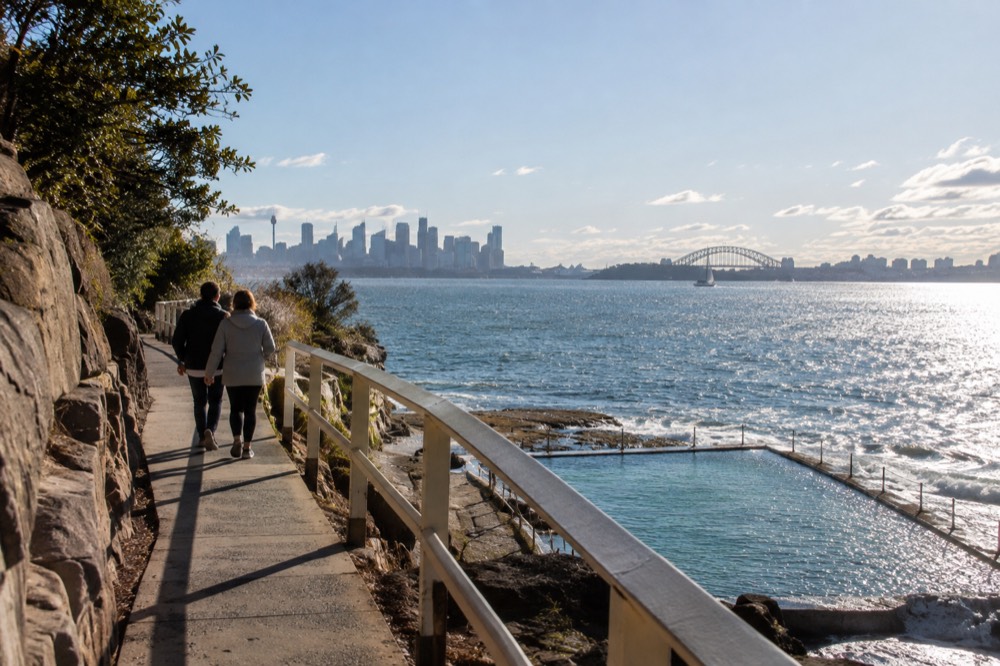
The swimming trade is real, though. Ocean pools soften it: Bondi Icebergs, Bronte and Wylie's are open through winter, and the water is cold rather than impossible. The Sydney in winter guide covers the full cold-season case. What winter genuinely cannot offer is the beach-day postcard, and visitors who arrive in July expecting one will be disappointed by the 9 °C mornings even when the afternoon delivers 17 °C of sunshine.
Winter's ace is Vivid Sydney, which runs 22 May to 13 June in 2026 and is scheduled for 28 May to 19 June in 2027. More than 80% of the festival is free, including the 6.5 km Vivid Light Walk, and the 2025 edition drew 2.53 million visitors. That makes late May and early June the one winter-adjacent window with peak-level crowds, so if you want the lights, book early; if you want quiet, aim for late July or August instead. The site's Vivid Sydney guide handles the festival in full.
What About the Shoulder Months: April, May and September?
April, May and September are the connoisseur's months, each with a distinct character. April averages 22.5 °C and 9.1 clear days with autumn color in the parks; May is cooler at 19.5 °C but the clearest month outside winter at 9.5 clear days; September sits at 20.1 °C with the year's joint-fewest rain days and the whale season's northern migration in full swing. April averages 22.5 °C and 9.1 clear days with autumn colour in the parks, May is cooler at 19.5 °C but the clearest month outside winter at 9.5 clear days, and September at 20.1 °C has the joint-fewest rain days of the year (7.1) and the whale season's northern migration in full swing.
May deserves more attention than it gets. It is the start of the whale season, the start of Vivid in late May, and statistically clearer than any summer month. The catch is the light: 5.9 mean daily sunshine hours, the second-lowest of the year, and early sunsets once daylight saving ends. Daylight saving in NSW runs from the first Sunday in October to the first Sunday in April, per the NSW Government's official dates page, so October through April is when the long evenings exist.
September is the sleeper pick for a trip built around whales and coastal walking rather than swimming. The northern humpback migration peaks late June through July, but September still delivers sightings, the water is at its coldest of the year after winter, and the spring warmth arrives in the air before it arrives in the sea. The Sydney coastal walks are at their best in these months: warm enough to walk all day, cool enough that the exposed sections stay comfortable.
Which Month Is the Worst to Visit Sydney?
February is the worst month on the numbers: it pairs the year's second-highest rainfall, 119.3 mm, with its fewest clear days, 5.3, inside the peak-season crowd and price window, and it is the height of extreme UV. June is the riskiest on rain, wetter still at 133.1 mm, but at least it is cheap and quiet, which February is not. February pairs the year's second-highest rainfall (119.3 mm) with its fewest clear days (5.3), inside the peak-season crowd and price window, and it is the height of extreme UV. June is wetter still at 133.1 mm, but it is at least cheap and quiet, which February is not.
The February case is worth spelling out because it inverts expectations. Visitors book it for the summer fantasy and get the muggiest, greyest, most crowded version of the city. March is nearly as wet (131.6 mm, the most rain days at 9.9), but at least the school holidays have ended and prices step down. If summer is your only window, January beats February on cloud statistics and December beats both, though all three carry extreme UV where sun protection is non-negotiable from mid-morning.
One scheduling note that cuts across every month: NSW public holidays change the arithmetic. A public holiday caps Opal travel at the cheaper weekend rate, so a holiday Monday is paradoxically the cheapest day to move around the city, while also being a day when locals pack the beaches and parks. The Sydney public holidays guide lists them all.
How Do You Pick the Right Month for Your Trip?
Match the month to your priority, because Sydney has no month that is bad at everything: swimmers take December to February, whale watchers take August to November for the southern migration, festival travelers take late May to June for Vivid, and value hunters take July or August. Book November, take October if the dates suit, and never assume summer is the answer. Swimmers should take December to February and accept the clouds, whale watchers should take August to November for the southern migration, festival travellers should take late May to June for Vivid, and value hunters should take July or August for the clearest skies and lowest prices of the year. The table below compresses the whole decision:
| If your priority is... | Best months | Why |
|---|---|---|
| Beach and swimming | Dec-Feb | Warmest water, longest days, extreme UV |
| Whale watching | Aug-Nov | Southern migration brings cows and calves close to shore |
| Festivals and lights | Late May-Jun | Vivid Sydney, more than 80% of it free |
| Clear skies and photos | Jul-Aug | 12.0 and 13.4 mean clear days, the year's best |
| Low crowds and prices | Jun-Aug (excl. Vivid) | Winter shoulder, outside school holidays |
| The all-round best bet | Oct-Nov | Warm, dry-ish, pre-peak, whales still passing |
However you choose, the harbour is the constant. The Sydney Harbour Sightseeing Cruise runs morning and afternoon departures and costs from US$28.53, making it one of the cheapest ways on the water in any season; on a clear August day or a warm November afternoon it earns its keep equally.
For everything else the city offers in each window, the site's things to do in Sydney hub is organised by area and season, and a fuller treatment of this question, including the school-holiday calendar and pricing detail by quarter, sits in the best time to visit Sydney guide. This page exists to answer the one question cleanly: on the evidence, book November, take October if the dates suit, and never assume summer is the answer.
Common Questions About the Best Month to Visit Sydney
What is the best month to go to Sydney?
October or November, with November the narrow winner. Temperatures average 22-24 °C, rain days sit near the annual low, whale season runs to the end of November, and the December peak crowds and prices have not arrived. February, the postcard summer month, is statistically the cloudiest of the year.
Which month is the best to visit Sydney?
November. It combines a 23.7 °C average maximum, the tail of the whale migration, shoulder-season pricing and long evenings from daylight saving. October is the close runner-up with slightly cooler days and marginally better cloud statistics.
What is the rainiest month in Sydney?
June, averaging 133.1 mm over the long-term record, wetter than any summer month. February is second at 119.3 mm. Rainfall in Sydney is spread across the year rather than packed into a wet season.
Is Sydney worth visiting in winter?
Yes. July and August have the clearest skies of the year, daytime highs of 16-18 °C, the lowest prices and the thinnest crowds, plus Vivid Sydney in late May and June if you time it. You trade warm swimming for reliable light.
What is the cheapest month to visit Sydney?
July and August, outside the Vivid window. Winter is Sydney's low season: [accommodation](https://booking.tpk.ro/ndznHj9h) drops, the skies are the clearest of the year, and public-holiday Opal caps make getting around cheaper still.