Where Does Bondi Coastal Walk Start?
The Bondi to Coogee coastal walk starts at the south end of Bondi Beach, at the Bondi Icebergs pool. Here is exactly where to begin, how to get there and what to expect.
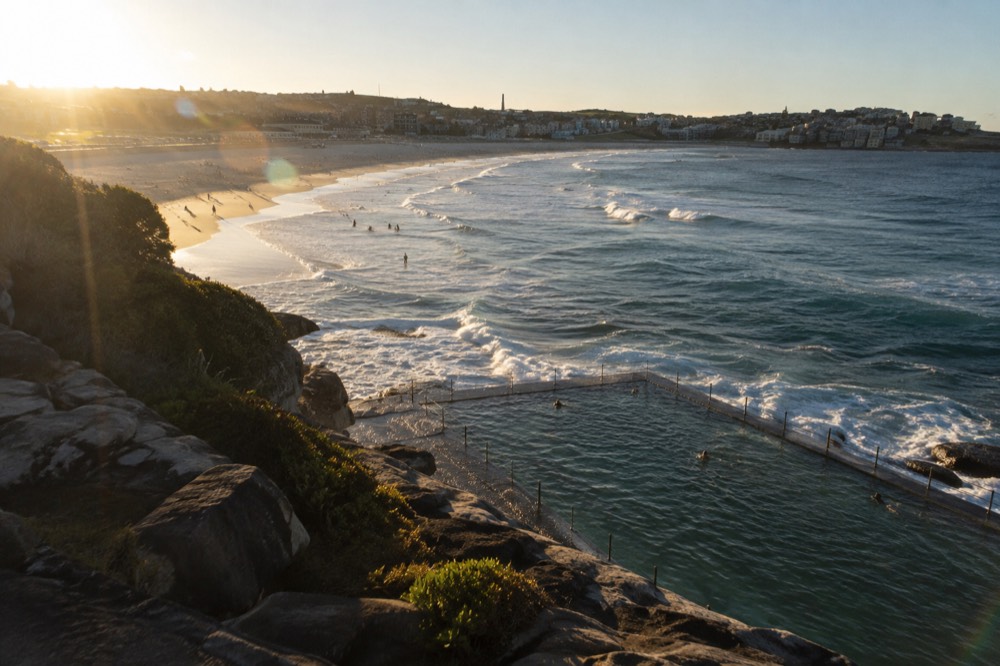
The Bondi to Coogee coastal walk is one of Sydney's best-known free experiences, and every year thousands of people set out to do it. Yet a surprising number of them start in the wrong place, or set off from the middle and miss the best cliff sections entirely. The starting point is specific, easy to reach by public transport, and worth getting right, because the first twenty minutes of the walk are among its most photographed.
Where Does Bondi Coastal Walk Start?
The walk starts at the southern end of Bondi Beach, at the Bondi Icebergs, a 50-meter ocean pool perched on the rocks and run by a swimming club rather than the council. The path begins on the headland immediately above the pool, and the starting point is marked by one of the most recognizable buildings on the whole coastline. From the Icebergs, a sandstone path climbs the headland past the Bondi Surf Bathers' Life Saving Club and heads south along the cliffs toward Tamarama, Bronte, Clovelly and finally Coogee. The full route is about six kilometres one way and takes most walkers between one and a half and two hours without stops. There is no ticket, no gate and no booking; the path is a public coastal reserve that anyone can walk at any time of day, and the starting point is marked by one of the most recognisable buildings on the whole coastline.
The starting point is unmissable once you know what to look for. Bondi Beach curves in a broad arc, and at its southern tip sits Bondi Icebergs, a 50-metre ocean pool perched on the rocks and run by a swimming club rather than the council. The path begins on the headland immediately above it. If you can see the white walls of the Icebergs pool against dark rock, you are standing at the start.
Most locals treat the Icebergs as the official beginning because the terrain immediately after it is the walk's signature: a cliff-top stretch of sandstone and heath with the ocean below. Starting anywhere else, such as at Tamarama or Bronte, means skipping that stretch entirely, and it is the part that appears on most postcards.
If you want the fuller picture on the whole route, our Bondi to Coogee coastal walk guide covers every section, detour and swimming stop along the way, and our guide to Bondi Beach explains the suburb itself, its surf culture and its food scene.
How Do You Get to the Bondi End of the Walk?
Bondi Beach is about 8 kilometers from the Sydney central business district, and there is no train station there. The usual public transport route is a train to Bondi Junction, then a frequent bus down to the beach, taking roughly 10 to 15 minutes more. A taxi or rideshare from the city takes around 20 to 30 minutes depending on traffic. The usual public transport route is a train to Bondi Junction, then a frequent bus down to the beach, which takes roughly 10 to 15 minutes more. With an Opal card or a contactless card, the whole trip counts toward the normal daily fare caps, which run at $9.65 on Fridays, weekends and public holidays and $19.30 Monday to Thursday. A taxi or rideshare from the city takes around 20 to 30 minutes depending on traffic, and costs far more than the capped fare.
The bus drops you on Campbell Parade, the road that runs along the back of the beach. From the bus stop it is a flat walk of about 400 metres south along the promenade to the Icebergs. If you are driving, paid parking exists around Bondi but fills very early on warm weekends, and street parking near the beach is timed and expensive; public transport is the sensible choice on any day worth walking in.
One detail worth knowing before you plan the trip: the return leg. The walk ends at Coogee, which is in a different transport corridor, so many people walk one way and catch a bus back to the city from Coogee, or retrace their steps. Building the return into your plan from the start saves standing at a bus stop figuring it out later.
| Transport option | Approximate time from the CBD | Notes |
|---|---|---|
| Train to Bondi Junction + bus to the beach | 35-45 minutes | The standard route; no train reaches Bondi Beach itself |
| Bus from the city via Bondi Junction | 40-50 minutes | Runs frequently along the same corridor |
| Taxi or rideshare | 20-30 minutes | Traffic-dependent; costs well above the Opal cap |
| Driving | 20-30 minutes | Paid, timed parking; fills early on weekends |
Which Direction Should You Walk?
Start at Bondi and walk south to Coogee. This is the most popular direction and the one most guides recommend, because the morning sun stays mostly behind you, the prevailing sea breeze pushes at your back rather than your face, and the walk finishes at Coogee, where the foreshore is gentler and more relaxed for a swim and a late lunch. Walking Bondi to Coogee means the sun is mostly behind you in the morning, the prevailing sea breeze pushes at your back rather than your face, and the walk finishes at Coogee, which has a gentler, more relaxed foreshore for a swim and a late lunch. The reverse direction works fine too, and some walkers prefer it because it ends at Bondi, where the cafes and nightlife are stronger, so the choice comes down to where you would rather finish.
The difference is real rather than theoretical. In the morning the light comes from the east over the Pacific, and a southbound walker photographs the cliffs and ocean without shooting into glare. By afternoon, when the sea breeze has built, a northbound walker gets the wind head-on for the exposed Clovelly-to-Bronte sections. Neither direction is wrong; the southbound route is simply the easier one to plan around.
There is also the question of tides and swell, which matter more than direction. The path stays above the waterline in almost all conditions, but in big swell the spray can wash over lower sections near Marks Park, and the ocean pools along the route, including the free Bronte Ocean Pool and the North Bondi Children's Pool, sometimes close when the sea is heavy. Checking conditions on the day costs nothing.
If morning light on water is what draws you to Sydney, the harbour offers its own version of it. The Harbour Sunrise Kayak Tour paddles Sydney Harbour in the first light of the day, and it pairs naturally with a coastal walk on a different morning of the same trip.
What Route Does the Walk Follow?
From Bondi Icebergs the path climbs over the headland, past Hunter Park and Marks Park, then descends to Tamarama Beach, climbs again to Bronte, crosses the Bronte cutting, rounds Clovelly and Gordons Bay, and finishes at Coogee. In total the route covers about six kilometers of cliff path, steps, beach promenade and one short road section near Clovelly. In total the route covers about six kilometres of cliff path, steps, beach promenade and one short road section near Clovelly. The path is signposted at every decision point, and getting lost is close to impossible, which is one reason no guided version of the walk exists as a bookable product.
Each section has its own character. The Bondi-to-Tamarama stretch is the most exposed and the most spectacular, with bare sandstone and heathland and the ocean directly below. Tamarama is a small, steep-sided beach that locals call Glamarama, and it sits in a deep cove. Bronte has a grassy park behind the beach and its ocean pool. Clovelly is narrow and sheltered, more like a channel than a beach, and Gordons Bay is a tiny, boat-filled cove reached by a fisher's path. Coogee, the end of the line, is a wide, family-friendly bay.
The walk's one genuine fork is at Waverley Cemetery, where the path splits around the cemetery grounds. Both routes rejoin; the lower one runs closer to the water and past the cemetery's cliff edge, and it is the more scenic of the two. Allow a little extra time if you want to wander among the cemetery's headstones, which sit on one of the most dramatic pieces of burial ground in Australia.
| Section | Share of the route | Character |
|---|---|---|
| Bondi Icebergs to Tamarama | Roughly a quarter | Exposed cliff path, the walk's signature stretch |
| Tamarama to Bronte | Roughly a sixth | Coves, cemetery fork, grassy park at Bronte |
| Bronte to Clovelly | Roughly a quarter | Steps and the Bronte cutting |
| Clovelly to Coogee | Roughly a third | Sheltered channel, Gordons Bay, arrival at Coogee |
How Long Does the Walk Take?
Most people take between one and a half and two hours to walk the full Bondi to Coogee route without stopping, and three to four hours at a relaxed pace with swims and cafe stops. The path is about six kilometers, runners finish in under an hour, and families with young children should plan on most of a morning with breaks built in. The path itself is about six kilometres, and the cumulative stairs add real effort: the route climbs and descends every headland rather than staying level, so it feels longer than its distance suggests. Runners do it in under an hour; families with young children should plan on most of a morning, with breaks built in.
The honest planning advice is to treat the walking time as a floor, not an estimate. Tamarama, Bronte and Coogee all have ocean pools, Bronte and Coogee both have cafe strips, and the cemetery and the Gordons Bay fisher's path both reward a slow pass. On a warm weekend the path is also crowded, and crowd flow slows you at every pinch point, particularly the stair sections between Bronte and Clovelly.
Water and sun protection matter more than pace. Sydney's UV index passes the protection threshold of 3 on most days of the year and reaches extreme levels of 11 or above in summer, which runs December through February. There is little shade on the exposed sections, and the official rip current advice from Beachsafe is worth reading before you swim at any stop along the way: swim between the red and yellow flags, at a patrolled beach, during patrol hours.
Patrol coverage along the route is better than most visitors expect. Waverley Council's professional lifeguards patrol Bondi, Bronte and Tamarama year-round, with hours from 6am to 7pm in the high season of October to April and 7am to 5:30pm from May to September, and Coogee is also patrolled year-round by council lifeguards. That said, patrol hours vary by beach and season, so check the signs at each beach before swimming.
When Is the Best Time of Day to Start?
Mid-morning is the sweet spot for most walkers: start between 9am and 10am to get the light without the crowds, and reach Coogee around lunchtime. Sunrise starts are quieter and photograph beautifully, but the path is unlit and the cliff sections are dark before dawn, so a headlamp or good ambient light matters. Late afternoon starts are riskier in summer. Sunrise starts are quieter and photograph beautifully, but the path is unlit and the cliff sections are dark before dawn, so a headlamp or good ambient light matters. Late afternoon starts risk finishing the exposed sections in the hottest part of the day in summer, and in winter, June to August, the sun sets early enough that a 3pm start means finishing in twilight, so the season genuinely changes the answer.
The seasonal picture matters more here than in most Sydney itineraries, and it runs against intuition. June is Sydney's wettest month on the long-run averages, with 133.1 millimetres of mean rainfall, wetter than any summer month, while August has the most clear days of any month at 13.4 on average. February, in the middle of peak season, is statistically the city's cloudiest month. Winter walks, in other words, are often clearer than summer ones; the days are simply shorter and cooler, with mean maximums of 16.4 to 17.9 degrees Celsius in July and August.
Weekends change the calculus. On Saturdays and Sundays, particularly in warm weather, the path between Bondi and Tamarama can feel like a procession, and the cafes at Bronte and Coogee queue out the door. A weekday start gives you the same views with a fraction of the foot traffic. Public holidays behave like peak weekends, and the NSW public holiday calendar is worth a glance when you plan, since holiday dates shift each year.
Do You Need a Guide for the Walk?
No. The Bondi to Coogee walk is free, signposted and self-explanatory, and no guided version of it exists as a bookable product. The only paid options nearby are private guiding services, and for this route they add little: the path is public, the signage is clear, and the walk's pleasures are the views and the swimming stops, not hidden information. The only paid options nearby are private guiding services, and for this route they add little: the path is public, the signage is clear, and the walk's pleasures are the views and the swimming stops, not hidden information. Save the guided-walk budget for a part of Sydney where a guide genuinely changes the experience, such as The Rocks, where two centuries of colonial history sit in plain sight and a casual stroll walks right past them.
What a guide does for The Rocks, a boat does for the harbour. If your Sydney trip has room for one paid morning alongside the free coastal walk, a harbour sightseeing cruise shows you the same city from the water, and a sunrise kayak tour gets you onto the water itself. Neither replaces the walk; they simply round out a trip that is otherwise done on foot.
For the walk itself, the practical preparation is modest. Wear shoes with grip, because the sandstone steps are polished smooth in places. Bring water, a hat and sunscreen in every season. Check the Beachwatch water quality site if you plan to swim, especially after rain: the official advice is to stay out of the water for up to one day after heavy rain at ocean beaches, and up to three days at harbour and estuarine swim sites.
Our Sydney coastal walks guide places this route among the city's other shoreline paths, including the Spit to Manly walk, and our Coogee Beach guide covers the suburb where the walk ends. For a broader orientation before the trip, Sydney Travel Guide is the place to start.
Common Questions About the Bondi to Coogee Walk
Where does Bondi Coastal Walk start?
It starts at the southern end of Bondi Beach, at the Bondi Icebergs ocean pool. The path climbs the headland above the pool and heads south toward Tamarama, Bronte, Clovelly and Coogee.
How long is the Bondi to Coogee walk?
About six kilometres one way. Most walkers take one and a half to two hours without stops, or three to four hours at a relaxed pace with swims and cafe stops.
Is the Bondi to Coogee walk free?
Yes. The path is a public coastal reserve with no entry fee, no ticket and no booking. The only costs along the way are optional: food, drink and the Bondi Icebergs pool entry if you want to swim there.
Can you walk the Bondi to Coogee route in winter?
Yes, and winter is often clearer than summer. August averages the most clear days of any month in Sydney. The trade-off is shorter days and cooler temperatures, with mean maximums of 16.4 to 17.9 degrees Celsius in July and August.
Where does the walk finish?
At Coogee Beach, about six kilometres south of the start. Coogee has a grassy foreshore, ocean pools and cafe strips, and buses run from Coogee back toward the city.
Is the walk suitable for children?
Mostly, with supervision. The path is paved and signposted but includes many stairs and exposed cliff sections. Most families do it in sections rather than end to end, and Bronte and Coogee are the most child-friendly stops.