What Can I Do on a Day Trip to Royal National Park?
A practical plan for one day in Royal National Park: getting there by train, the best short walks, where to swim and picnic, entry costs and the best season to go.
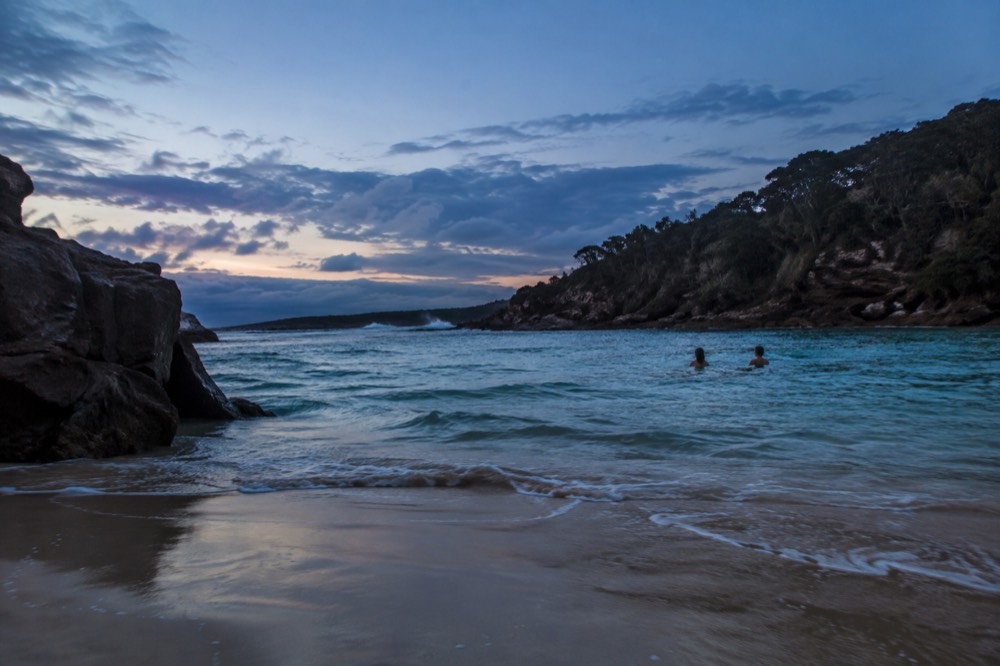
What Can I Do on a Day Trip to Royal National Park?
What Can I Do on a Day Trip to Royal National Park?
In one day you can walk a clifftop stretch of the Coast Track, swim at Wattamolla's sheltered lagoon, picnic at Garie or Audley, and still be back in central Sydney by early evening. The park sits about an hour south of the city, entry costs $12 per vehicle per day, and arriving by train and ferry avoids the fee entirely. Most first-time visitors build their day around one walk, one swim and one viewpoint rather than trying to see everything.
That is the honest shape of a good day here. Royal National Park is big enough that a whistle-stop tour of every highlight leaves you in the car more than on your feet. Pick one of the park's three distinct zones, the coast, the Hacking River valley at Audley, or the waterfalls of the north, and give it a proper half-day. If you have never been, the coast wins almost every time: sandstone cliffs, isolated beaches and a lagoon that is calm enough for cautious swimmers.
The park is the oldest national park in Australia and, as our full Sydney Travel Guide to the area explains, one of the oldest protected landscapes of its kind anywhere in the world. Locals call it "the Royal", and it functions as Sydney's back garden: on a warm weekend the Wattamolla car park fills by mid-morning, while midweek you can have a beach to yourself. Timing matters as much as route choice.
Start early, whatever you choose. The park's most popular spots thin out dramatically after 3pm, and the light on the cliffs is at its best late in the day. A day trip works year-round, but the experience differs sharply by season, which we cover in full below.
How Do You Get to Royal National Park from Sydney?
Two car-free routes work well: the train to Cronulla on the Illawarra line, then the small ferry across Port Hacking to Bundeena, or the train to Waterfall for the northern waterfalls. The adult Opal fare from the city sits in the 20-35 km band, $6.20 peak or $4.34 off-peak each way, and the $12 per-vehicle park entry fee does not apply if you arrive by train, ferry or on foot. Driving takes about an hour from the CBD in light traffic.
| Option | Rough time from the CBD | Cost notes |
|---|---|---|
| Train to Cronulla, ferry to Bundeena | About 1 hour 15 minutes plus the ferry crossing | Opal fare 20-35 km band; ferry is a separate private service, check its current fare and timetable |
| Train to Waterfall (northern walks) | About 1 hour | Opal fare, same distance band |
| Drive via Princes Highway or Grand Parade | About 1 hour off-peak, longer on summer weekends | $12 per vehicle per day park entry, payable at entry stations, machines or the Park'nPay app |
The Bundeena ferry deserves a caveat: it is a small private operator, its fares and timetable are not part of the Opal system, and schedules change with the seasons, so check the current timetable before you commit. The crossing itself is short and pretty, gliding across Port Hacking with views back toward the suburbs. Once in Bundeena you are a 15-minute walk from the start of the coast sections, or you can walk straight onto the Coast Track from the village.
Driving gives you the most flexibility and the most frustration. Summer weekends bring queues at the Wattamolla and Garie gates, and the park's single-lane access roads were not built for the crowds the city now sends down. If you drive, arrive before 9am in warm months or after 4pm. Our guide to day trips from Sydney without a car covers the train-and-ferry option in more detail, and the Royal National Park guide maps the access points.
One note on tap-on, tap-off: the same Opal rules apply down here as in the city, so a contactless card works identically to an Opal card, and the off-peak discount of 30% applies on the train outside weekday peak hours.
Which Walks Should You Do with Limited Time?
With one day, choose either the Bundeena to Wedding Cake Rock stretch of the Coast Track, roughly an hour each way at an easy pace, or the shorter Wattamolla circuit that combines a lagoon, a beach and clifftop views in under two hours. Do not attempt the full Coast Track: it is a two-day walk with camping, and even strong walkers cannot compress it into a day trip comfortably. The sandstone cliffs are unfenced in places, so stay behind the barriers at lookouts.
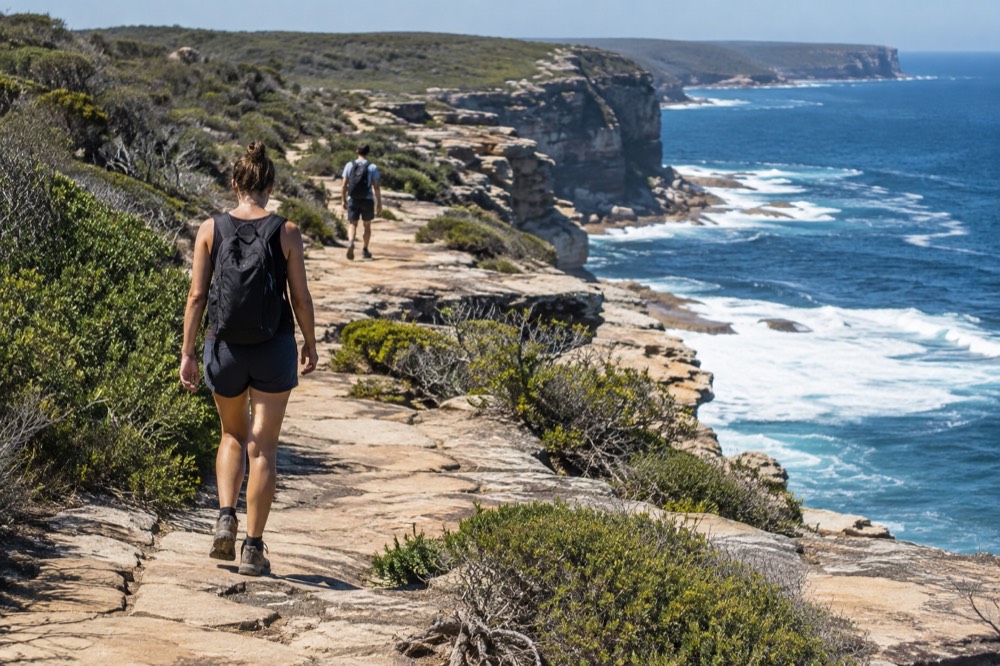
The Bundeena-to-Wedding-Cake-Rock walk is the classic taste of the park. You leave from the village, pass through eucalypt forest that opens onto the sea, and arrive at a striking white rock formation that has been fenced off after sections of the cliff edge crumbled. The fence is not bureaucratic caution: the rock is genuinely unstable, and people have ignored the barriers with serious consequences. Photograph it from behind the line and keep back from unfenced edges elsewhere on the track.
If you are travelling with children or prefer a swim over a long walk, base yourself at Wattamolla. A short path from the car park reaches a lagoon where the creek meets the sea, and the calm water behind the sand spit is the most forgiving swimming spot in the park. From there a clifftop loop gives you the views without a big commitment.
Walkers with more time and legs can continue south from Wattamolla toward Garie, one of the park's most photographed surf beaches. The stretch is exposed: carry more water than you think you need, because the creeks are not reliable drinking sources and summer temperatures regularly pass 30 °C. If you enjoy this kind of terrain, the city-side equivalent is the Bondi to Coogee coastal walk, and our overview of Sydney's coastal walks ranks the Royal's tracks alongside them.
Where Can You Swim, Picnic and Spot Wildlife?
Wattamolla's lagoon is the safest swim in the park because the sand spit blocks most of the surf, but no beach in the Royal is a patrolled surf beach like Bondi or Manly, so swim cautiously and never alone. Audley, on the Hacking River, is the picnic heart of the park, with lawns, shade and boat hire in warm months. Early morning and late afternoon are the best times to see eastern water dragons, goannas, black cockatoos and, in quieter corners, swamp wallabies.
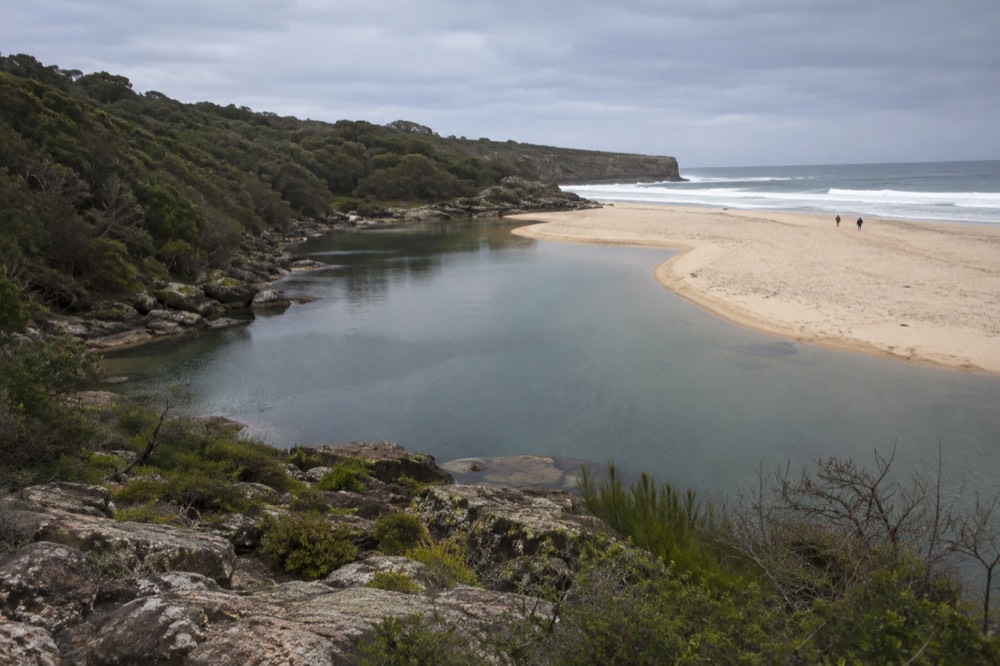
Be straight with yourself about the swimming here. The Royal's ocean beaches are beautiful and isolated, which is exactly why they demand respect: there are no red and yellow flags, no lifeguards on these stretches, and rip currents are the number one hazard on the NSW coast. The official guidance from Surf Life Saving's beach safety program is to swim at patrolled beaches between the flags, and if you are caught in a rip, stay calm, raise an arm and call for help, float with the current, or swim parallel to the beach toward breaking waves. Treat the lagoon as the swim and the ocean as the view, and you will have a good day.
Picnicking is the other quiet pleasure of the park. Audley, about 15 minutes' drive inside the southern entrance, has sheltered lawns beside the river and the atmosphere of an old-fashioned park rather than a wilderness. Garie has picnic tables above the beach with the best outlook of the three main hubs. Bring everything you need: the park has limited food outlets, and what exists closes early or shuts entirely outside peak season.
Wildlife watching rewards patience more than distance. The black cockatoos are hard to miss around Bundeena, water dragons sun themselves on rocks beside the creeks, and goannas lumber through the campground areas. Wallabies are shyer and best looked for at dawn along the forest edges near the waterfalls in the park's north.
What Does It Cost, and When Is the Best Time to Go?
Entry is $12 per vehicle per day, charged at the park's entry stations, pay machines or through the Park'nPay app, with no charge for arriving on foot, by bike or by train, and the fee schedule is published by NSW National Parks. The best months are arguably outside summer: long-run Bureau of Meteorology records show June is actually Sydney's wettest month at 133.1 mm on average, while August is its clearest with 13.4 mean clear days.
Spring, September to November, delivers mild temperatures and green scenery before the summer crowds.
| Month | Mean max °C | Mean rainfall mm | Rain days ≥1 mm | Mean clear days |
|---|---|---|---|---|
| January | 26.0 | 101.2 | 8.6 | 6.8 |
| April | 22.5 | 126.5 | 8.9 | 9.1 |
| June | 17.0 | 133.1 | 8.8 | 9.1 |
| August | 17.9 | 80.2 | 7.1 | 13.4 |
| October | 22.2 | 76.7 | 7.9 | 8.1 |
Those averages come from the Bureau of Meteorology's long-term normals for Sydney and they overturn the usual assumption that an Australian coastal city is wettest in summer. February, the middle of peak season, is statistically the cloudiest month of the year with just 5.3 mean clear days, while midwinter August delivers the clearest skies. A winter day trip to the Royal is genuinely underrated: fewer people, crisp walking weather, and the waterfalls running harder after rain.
Whenever you go, pack against the sun rather than the calendar. Sydney's UV index reaches extreme levels of 11 or more in summer and still passes the protection threshold of 3 in winter, so sunscreen, a hat and water are non-negotiable in every season. The bush fire danger period in NSW runs from 1 October to 31 March, and on severe fire-weather days sections of the park can close at short notice, so check the alerts page on the NSW National Parks site before you set out.
Budget-wise the day is cheap: a train-and-ferry arrival plus a packed lunch can come in under A$30 per person, while a driving day for a family of four costs the $12 entry fee plus fuel and food. Neither figure includes the ferry's fare, which is set by its private operator and changes periodically.
Should You Take a Guided Tour Instead?
A guided tour makes sense if you want interpretation rather than exercise: an all-inclusive day trip handles transport, meals and entries and a local guide explains the geology and bush ecology you would otherwise walk straight past. It costs more than a self-guided day, and you trade the freedom to linger at Wattamolla for the comfort of not planning anything. The Royal itself has no equivalent full-day guided product, so most tour buyers head to the Blue Mountains instead.
That last point is worth being honest about. The roster of guided day trips from Sydney is dominated by the Blue Mountains, and the Blue Mountains all-inclusive day trip with a local guide is the strongest of them, running about 10 hours with transport, entries and food bundled into one price. If your real goal is "see dramatic Australian bushland with someone else driving", that product serves it better than any improvised Royal itinerary.
If your heart is set on the Royal specifically, the self-guided day above is the way to do it. The park's tracks are well signposted, the train-and-ferry access is straightforward, and the money you save over a guided product buys a very good lunch in Bundeena. The middle path is a half-day guided walk in the park run by small independent operators, which you can find through the NSW National Parks events listings; availability varies by season.
Common Questions About a Royal National Park Day Trip
What can I do on a day trip to Royal National Park?
Walk a clifftop stretch of the Coast Track from Bundeena to Wedding Cake Rock, swim at the sheltered Wattamolla lagoon, picnic at Audley or Garie, and look for goannas, water dragons and black cockatoos. Arrive by train and ferry to skip the $12 per-vehicle entry fee, and pick one walk rather than attempting the full coast route.
Can you do Royal National Park without a car?
Yes. The train to Cronulla plus the short private ferry to Bundeena puts you at the start of the coast walks in about an hour and a half from the city, and the train to Waterfall serves the northern waterfall tracks. Arriving by train also avoids the per-vehicle park entry fee entirely.
Is it safe to swim at Royal National Park beaches?
Only cautiously. The park's ocean beaches are not patrolled surf beaches, and rip currents are the main hazard on this coast. Wattamolla's lagoon, sheltered behind a sand spit, is the most forgiving option. The official advice is to swim at patrolled beaches between the red and yellow flags, so treat any swim in the park as an unpatrolled one and never swim alone.
How much time do you need in Royal National Park?
One full day is enough for a walk, a swim and a picnic spot, arriving mid-morning and leaving before dusk. Two days lets you add the northern waterfalls or an overnight camp on the Coast Track, but a rushed two-day attempt at everything is worse than a relaxed single-focus day.
What is the best month to visit Royal National Park?
Spring, September to November, is the sweet spot: mild walking temperatures, green bush and lighter crowds than summer. Winter is underrated too, since Sydney's long-run weather records show August is the city's clearest month and June its wettest, the opposite of what most visitors expect.
Do you have to pay to enter Royal National Park?
Yes, if you drive: $12 per vehicle per day, payable at entry stations, pay machines or via the Park'nPay app, with the fee schedule published by NSW National Parks. Arriving on foot, by bike or by train incurs no entry fee, and drivers of larger vehicles over eight seats pay a per-person rate instead.